
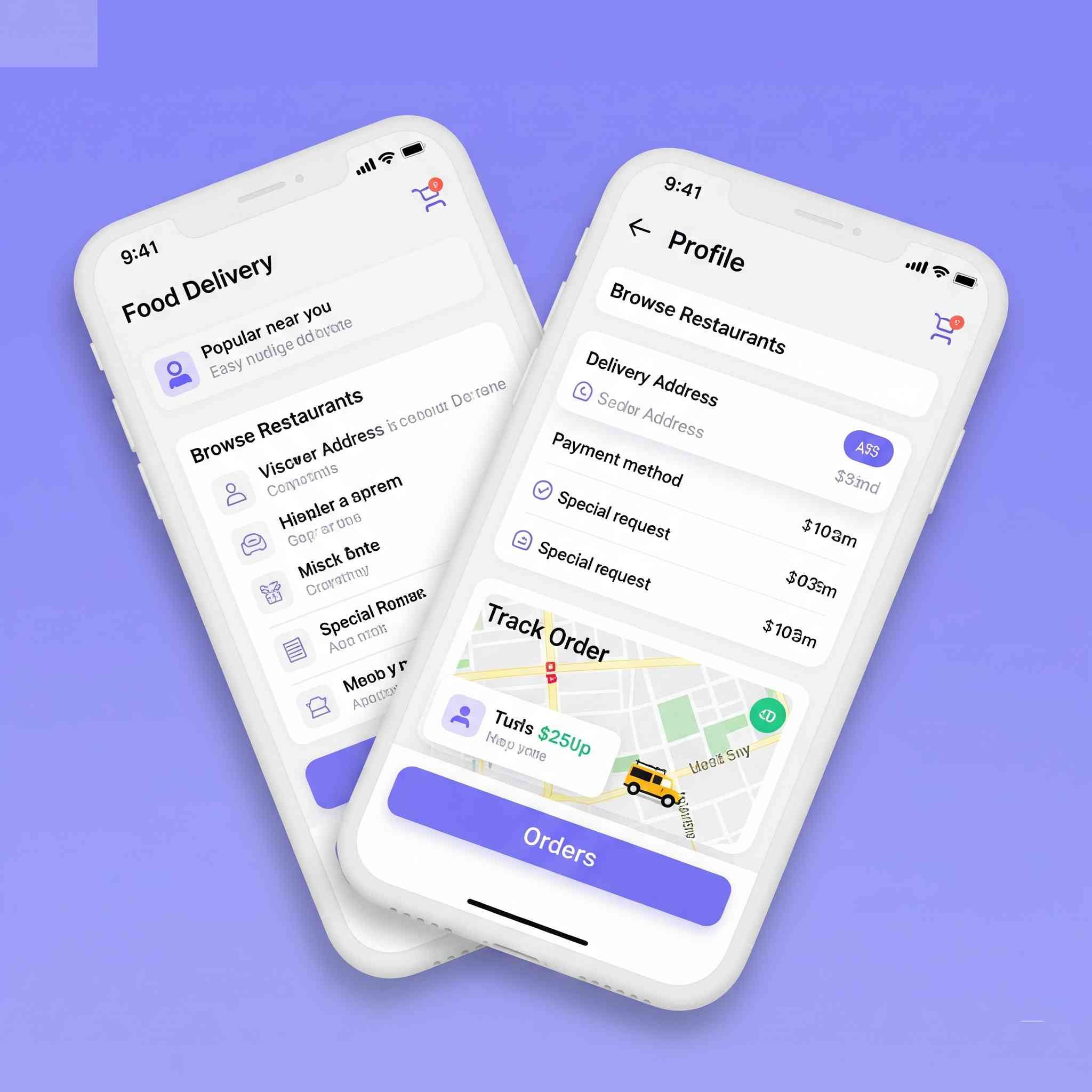
Delivery Agent Mobile Application
OrbioSolutions Pvt Ltd: Empowering Delivery Agents with a Custom Mobile Application This case study highlights Triophore’s expertise in developing specialized mobile applications and supporting backend services, specifically addressing OrbioSolutions Pvt Ltd’s need for a robust delivery management application within their e-commerce software stack. This solution is crucial for optimizing last-mile delivery operations.
The Challenge: Streamlining Delivery Management for E-commerce OrbioSolutions faced the common challenge of efficiently managing its delivery operations. The problem statement identifies a clear requirement for a delivery management application for their E-commerce software stack.
This challenge typically involves several key pain points:
Inefficient Delivery Processes: Manual assignment of deliveries, lack of real-time tracking, and inefficient route planning can lead to delays, increased fuel costs, and poor customer satisfaction.
Lack of Real-time Visibility: Both for the delivery agents and for OrbioSolutions’ central management, real-time updates on delivery status, agent location, and potential issues are crucial for effective operations.
Poor Communication: Without a dedicated app, communication between dispatchers, agents, and customers can be fragmented and inefficient, leading to misunderstandings and delays.
Proof of Delivery: Secure and reliable methods for confirming delivery (e.g., electronic signatures, photo proof) are essential for accountability and dispute resolution.
Scalability for Growth: As e-commerce operations grow, the delivery management system must be able to handle an increasing volume of orders and a larger fleet of delivery agents without performance degradation.
User Experience for Agents: The application needs to be intuitive, easy to use, and perform well in varying network conditions to minimize friction for the delivery agents who rely on it daily.
The Solution: A Comprehensive Mobile App and Backend for Optimized Deliveries Triophore provided a complete solution by developing both the mobile application for delivery agents and the necessary accompanying backend services:
Custom Mobile Application Development: Triophore designed and built a dedicated mobile application tailored to the specific workflows and needs of OrbioSolutions’ delivery agents. This app likely includes features such as:
Order Assignment & Management: Displaying assigned deliveries, order details, customer information, and delivery instructions.
Navigation & Route Optimization: Integration with mapping services to provide efficient routes and turn-by-turn directions.
Real-time Status Updates: Allowing agents to update delivery status (e.g., “Out for Delivery,” “Delivered,” “Attempted Delivery”) in real-time.
Proof of Delivery: Capabilities for capturing electronic signatures, taking photos, or scanning barcodes upon delivery.
Communication Tools: Facilitating communication with customers or dispatchers within the app.
Accompanying Backend Services: The mobile app relies heavily on robust backend services to function. These services would manage:
Order Data: Storing and retrieving delivery orders, customer information, and product details.
Agent Management: Tracking agent availability, assignments, and performance.
Real-time Tracking: Processing and storing real-time location data from agents, making it available to managers and customers.
Notifications: Sending push notifications to agents for new assignments or updates, and to customers for delivery status changes.
Analytics & Reporting: Collecting data on delivery performance for optimization.
Seamless Integration: The solution was designed to seamlessly integrate with OrbioSolutions’ existing e-commerce software stack, ensuring a unified operational flow.
Ongoing Maintenance and Support: Triophore’s commitment to continuous maintenance and support ensures the application remains up-to-date, secure, performs optimally, and adapts to evolving business requirements and technological advancements.
The Tech Stack: Building Responsive and Scalable Delivery Systems The chosen technology stack reflects a modern, cross-platform approach for mobile development, combined with a robust and scalable backend:
Flutter: Google’s UI toolkit for building natively compiled applications for mobile, web, and desktop from a single codebase. Flutter’s fast development cycles, expressive UI, and strong performance make it an excellent choice for creating a smooth and responsive delivery agent application across both Android and iOS devices, which is critical for agents’ daily workflow.
WebSockets: A protocol providing full-duplex communication channels over a single TCP connection. WebSockets are crucial for real-time features like live tracking of delivery agents’ locations, instant dispatch of new orders, or immediate status updates, ensuring low-latency communication between the mobile app and the backend.
Node.js: A JavaScript runtime known for its non-blocking, event-driven architecture. Node.js is highly efficient for building scalable backend services that handle a large number of concurrent connections, making it well-suited for processing real-time location data, managing order assignments, and serving API requests from numerous delivery agents.
MongoDB: A popular NoSQL document database. Its flexible schema is ideal for storing diverse and rapidly changing data associated with e-commerce deliveries, such as order details, customer information, delivery agent profiles, and dynamic location data. Its scalability also supports growing operational needs.
Firebase: A comprehensive mobile and web application development platform by Google. Firebase offers various services that would significantly enhance the delivery app:
Realtime Database / Cloud Firestore: For highly scalable, real-time data synchronization between devices and the backend, especially useful for live tracking and instant order updates.
Authentication: For secure user management of delivery agents.
Cloud Messaging (FCM): For sending push notifications to delivery agents (e.g., new order assignments) and customers (e.g., delivery status changes).
Cloud Functions: Serverless functions to handle backend logic triggered by events.
Related Case Studies
BioSensor Relay Mobile Application
In the rapidly evolving landscape of digital healthcare, remote patient monitoring (RPM) solutions are transforming how medical data is collected and analyzed. LifeSignals INC, a pioneer in wireless biosensor technology, sought to enhance the utility of their innovative Wireless ECG Patch.
Read MoreE Learning Platform for Compass Institute
In the rapidly evolving educational landscape, e-learning platforms have become indispensable tools for delivering flexible, accessible, and engaging learning experiences. Compass Institute, a renowned educational institution, sought to expand its reach and enhance its pedagogical methods by developing a comprehensive online learning platform. Triophore partnered with Compass Institute to design and develop a robust, user-friendly e-learning application that would cater to their diverse student body and course offerings.
Read More